So you want to sell digital products online. Smart move. Low overhead, high margins, and you can work in your pajamas. But here's the thing: most people mess this up before they even start.
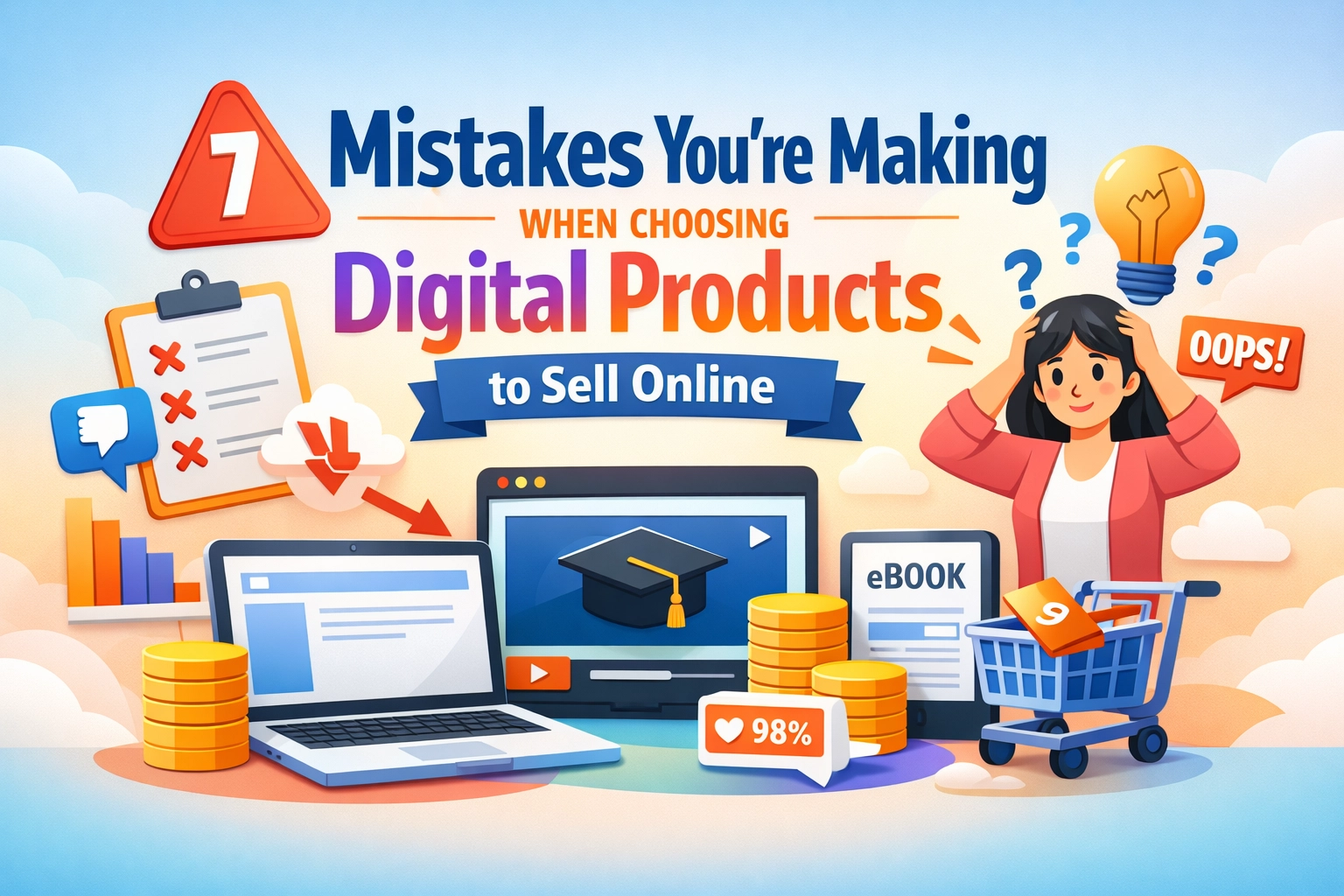
Choosing the wrong digital product is like picking the wrong horse at the races. You can work hard, hustle all day, and still end up broke and frustrated. Let's fix that. Here are the seven biggest mistakes people make when selecting digital products to sell online, and how to avoid them.
Mistake #1: Skipping Market Research Entirely
You know what your audience needs, right? Wrong.
This is the biggest trap. You spend weeks creating a product based on what you think people want, only to launch to crickets. Market research isn't optional: it's the foundation of everything.
Before you create anything, look at what people are actually searching for. Check forums, Reddit threads, Facebook groups. What questions keep popping up? What problems are people desperate to solve?

The data doesn't lie. Your assumptions do.
Mistake #2: Jumping Into Oversaturated Markets
"I'll sell motivational quotes!" "What about basic meal planners?"
Stop right there.
These markets are packed tighter than a Tokyo subway at rush hour. When you're competing with thousands of others selling the exact same thing, you're forced into a race to the bottom on price. And nobody wins a race to the bottom except maybe your competitors.
Instead, get specific. Don't sell "fitness eBooks": sell "strength training for busy parents who only have 20 minutes." Niching down isn't limiting yourself. It's making yourself findable.
At Ezy Learning, we focus on specific niches like health and fitness, business and making money, and productivity. Each category targets specific pain points, not generic topics.
Mistake #3: Building Your Magnum Opus First
Here's a story you've heard before: Someone spends six months creating a massive signature course. Hundreds of lessons. Workbooks. The whole nine yards. They launch it and… nothing.
Six months. Gone.
Your first product should be small. A mini-course. A focused guide. Something you can create and validate quickly. Test the waters before you build the yacht.

Start with a $6.97 eBook or a $7.95 video course. See if people actually want what you're offering. Then scale up.
Mistake #4: Assuming eBooks Are Still King
Ten years ago, everyone said "write an eBook." It was the golden ticket.
Today? Not so much.
eBooks still sell, but they're not the only game in town: and often not the best one. People's consumption habits have changed. Many prefer video courses, audio content, templates, or interactive workbooks.
Don't default to an eBook because that's what everyone used to do. Consider what format actually makes sense for your content and your audience. Sometimes a video course teaches better than text ever could.
Mistake #5: Ignoring the Power of Resell Rights
Here's something most people overlook: you don't always need to create from scratch.
Products with resell rights let you sell proven digital products as your own. You skip the creation phase entirely and jump straight to marketing and selling. It's like buying a franchise instead of starting a restaurant from scratch.
The real advantage? These products are already complete, tested, and ready to generate income. You can start selling today instead of six months from now. Plus, at prices like $6.97 for eBooks and $7.95 for video courses, your upfront investment is minimal.

The profit margin? That's all yours.
Mistake #6: Pre-Selling Without an Audience
Pre-selling is brilliant: when you have an audience.
But here's the reality: if you don't have at least a few hundred engaged followers or a budget for paid ads, pre-selling is just shouting into the void.
Too many new sellers try to pre-sell before they've built any kind of following. They put up a landing page, send it to their 47 Twitter followers, and wonder why nobody's buying.
Build first. Pre-sell second. Or start with affordable products that don't require massive validation campaigns. A $6.97 product is a much easier "yes" than a $497 pre-order for something that doesn't exist yet.
Mistake #7: Creating Products Nobody Actually Wants
This is different from skipping market research. This is about creating based on your passion instead of their problems.
You love ancient Roman history. Fantastic. But are people actually searching for digital products about ancient Roman history? Are they willing to pay for it? How many competitors already dominate that space?
Your product needs to solve a problem people know they have and are actively looking to fix. "How to make money online" works because people search for it. "The philosophical implications of Stoicism in modern society" is interesting, but probably not a best-seller.

Look at actual search volumes. Check Amazon's best-sellers in your category. Browse social media marketing courses or productivity guides that are already selling. See what's working, then create something better or more specific.
The Bottom Line
Choosing the right digital product isn't about luck. It's about strategy.
Skip the guesswork. Do the research. Start small. Test fast. And don't create products nobody wants to buy.
The digital product market is massive and growing. People are making real money selling eBooks for $6.97 and video courses for $7.95. But only if they choose the right products and avoid these seven mistakes.
Want to skip the creation phase entirely? Check out our catalog at Ezy Learning. Every product comes with resell rights, which means you can start selling today instead of months from now.
Smart choices now. Profits later. That's the game.